AI-powered Testing and Test Automation: (Not) the Same Approach
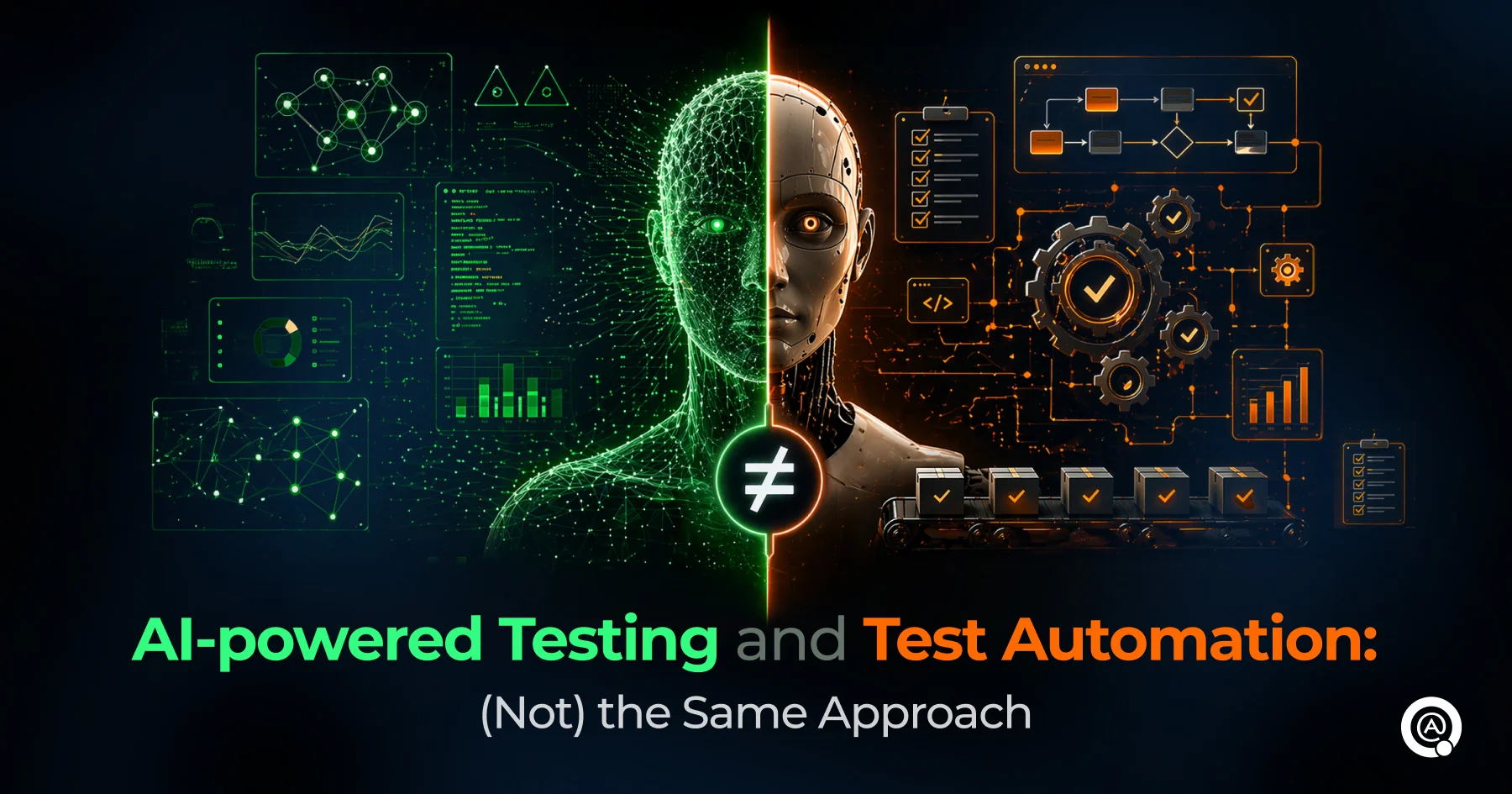
AI-powered testing refers to the use of machine learning and data-driven approaches to support test creation, analysis, and optimization, while test automation focuses on scripted, repeatable checks with predefined expected results.
Although these two approaches are often confused, and AI is sometimes seen as a “new and improved” version of automation, they fundamentally represent different concepts. Understanding this distinction is essential if you want to build a reliable and efficient testing process.
In this article, we’ll break down how these approaches differ, where each delivers the most value, and how to apply them in practice.
The first confusion: call everything “automation”
In many teams, “automation” has become a broad label for almost any activity that reduces manual effort. Scripted regression checks, test data generation, reporting workflows, and even AI-assisted test creation are often grouped together.
This creates a fundamental misunderstanding from the outset. While these approaches may all contribute to the testing process, they are designed for different purposes.
Let’s sort this out.
Real automation: what it actually is
To make automated testing easier to understand, let’s first look at who an Automation QA Engineer actually is. In simple terms, this is a tester who has a deep enough understanding of the testing process to turn critical checks into stable scripts, making validation faster, more scalable, and easier to repeat across releases.
You can think of them as an advanced version of a manual QA engineer. If your team has worked with automation testers, you have likely already seen how valuable this approach is for reducing the workload for the manual QA team and enabling broader coverage.
At its core, test automation is the execution of predefined, stable scripts that verify whether the system behaves exactly as expected. It relies on clear rules, fixed test data, and deterministic outcomes.
In practice, automation is used where consistency and predictability matter most:
- regression testing across builds
- API validation
- business-critical logic (e.g., calculations, permissions)
- cross-platform checks with fixed scenarios
- CI/CD pipelines where fast feedback is required
When system behavior is well understood and stable, automation delivers reliable, traceable, and repeatable results that teams can trust when making release decisions.
What is AI-powered testing?
AI-powered testing takes a completely different approach. Instead of following strict predefined instructions, AI tries to mimic aspects of human intelligence. It can analyze large volumes of data, recognize patterns, identify anomalies, solve problems, and learn from experience.
This makes AI especially powerful for tasks that are repetitive but complex – such as analyzing test logs, clustering failures, generating test scenarios, suggesting edge cases, or creating realistic test data. AI takes on the heavy analytical work, freeing testers and engineers to focus on interpretation, decision-making, and a deeper understanding of the product.
AI can even go further by “thinking” for us, summarizing complex information, uncovering hidden insights, or drawing conclusions from massive datasets.
However, this power comes with important risks. AI can hallucinate, miss critical details, or present overly confident conclusions. Another real danger is that when teams delegate too much thinking to AI, people may gradually lose deep context and understanding of the product they are building. You have likely seen a similar pattern in other areas too: the more blindly work is handed over to AI, the easier it becomes to lose visibility into how decisions are made and whether the output is actually correct. In testing, this becomes especially risky when teams rely on AI to generate checks or even write automated tests without having enough expertise to validate whether those tests are meaningful, correct, and aligned with real product risks.
What is the difference between AI and Automation?
As outlined above, AI and automation are designed to serve different purposes within the testing process. While they can complement each other, they are not interchangeable.
To make this distinction clearer, the comparison below highlights how each approach is typically applied:
Why does it matter for business?
From a business perspective, this is really about managing risk and investing wisely. When teams don’t clearly understand the difference between traditional automation and AI-powered testing, they often make expensive mistakes:
- They invest heavily in AI tools expecting the same reliability and predictability as classic automation, and then get disappointed when results turn out to be inconsistent or hard to trust.
- Teams continue pouring time and money into maintaining fragile automation scripts in areas where AI could bring much more value and adaptability.
- Loss of control over the product: from AI hallucinations and a lack of traceability to the loss of deep product knowledge when too much thinking is delegated to machines.
A clear understanding of what each approach is good at (and what it isn’t) helps businesses make much smarter decisions about:
- Where to invest their testing budget
- Which risks are they willing to accept
- How to balance speed, stability, and intelligence in their quality process
How AI and automation work together
There is a growing push to use AI in automated processes to further relieve manual QA teams for broader coverage. In many modern workflows, automation starts the process, executing predefined steps, running checks, or triggering pipelines. Then AI is brought in to guide the next steps: analyzing results, suggesting actions, or summarizing insights for the people monitoring the process.
This combination allows teams to move beyond simple execution. Automation handles consistency and speed, while AI adds context, flexibility, and decision support.
From a business perspective, this approach brings clear benefits:
- faster feedback loops and shorter release cycles
- reduced manual effort in analysis and triage
- better visibility into issues through summarized insights
- more adaptive workflows that can respond to changing conditions
We support the use of AI in testing because, when applied thoughtfully, it can bring real value to the testing process. That is why we are already actively integrating it into both manual QA and test automation workflows. At the same time, it is important to keep the risks in mind, as this approach also introduces real risks due to the AI’s limitations mentioned above: hallucinations, missing critical details, or presenting overly confident conclusions that are not fully accurate.
So, relying on AI without proper control can lead to incorrect decisions, overlooked defects, and reduced trust in the testing process. To address this, we use a human-in-the-loop approach. This means that while AI supports analysis and decision-making, final validation and critical decisions remain under human control. Testers and engineers review AI-generated insights, verify results, and ensure that important context is not lost.
In practice, this allows us to:
- benefit from AI speed and efficiency
- maintain accuracy and reliability
- keep deep product understanding within the team
As a result, we built a testing process that is faster, more controlled, and more trustworthy.
Thus, as we can see, humans continue to play a key role in testing – both in traditional software testing and as overseers during automated and AI-powered testing. By the way, if you’re interested in exploring in more depth whether AI will replace manual testers, feel free to read our article on this topic.
Conclusion
By the time you’ve reached this point, you hopefully have a clear understanding of the difference between test automation and AI-powered testing, and why these concepts should not be confused.
At the same time, it is clear that AI is rapidly gaining traction and becoming an integral part of modern testing processes. Combining automation and AI is the direction testing is moving toward. Our team has been actively using AI in testing for some time now, helping us improve efficiency, speed up manual effort, and gain deeper insights into product behavior.
If you are looking for support with validating your product, feel free to reach out. We can help you build a testing strategy tailored to your product – one that ensures both speed and reliability, without compromising quality.
AI-powered testing uses machine learning and data-driven techniques to support test creation, analysis, and optimization. It helps identify patterns, detect anomalies, and generate test scenarios, especially in complex or data-heavy environments.
Traditional automation relies on predefined scripts and expected results, making it highly predictable and stable. AI-based testing, on the other hand, can analyze data, adapt to changes, and generate new test scenarios, which makes it more flexible but less deterministic.
No. AI can significantly enhance testing processes, but it cannot fully replace structured, rule-based validation. Critical functionality, compliance requirements, and predictable regression coverage still require traditional testing and human oversight.
Yes – and this is currently the most effective approach for most teams. Automation provides the stable backbone, while AI enhances test creation, maintenance, failure analysis, and risk prioritization. Together, they create a balanced, scalable quality process.
Learn more from QATestLab


Related Posts:
About Article Author
view more articles