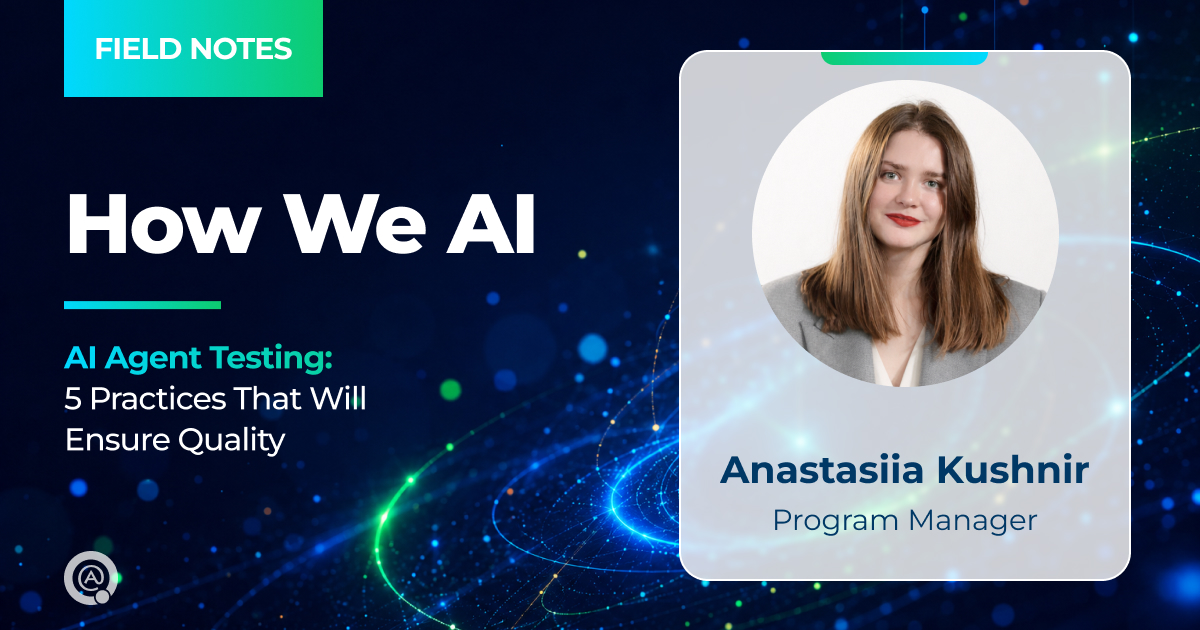
AI Agents Testing: 5 Practices That Will Ensure Quality
AI agents are rolling out across healthcare, enterprise, and e-commerce, making decisions that affect patients, customers, and revenue. Epic launched three clinical agents at HIMSS 2026. Salesforce closed 22,000 Agentforce deals in one quarter[1]. AI-driven traffic to retail sites jumped 1,200% year-over-year[2].
But the data shows that most organizations aren’t ready. Microsoft and The Health Management Academy found that 43% of healthcare executives are piloting AI agents, yet only 3% have deployed them in live workflows[3]. Salesforce’s 2026 Connectivity Report adds that 86% of IT leaders expect agents to create more problems than value[4]. The reason is quite simple: the existing quality culture isn’t up to date with the best practices.
What Are AI Agents (and Why Standard QA Isn’t Enough)
AI agents are autonomous software systems that observe context, plan actions, and execute them on their own. Unlike basic generative AI, agents can approve refunds, update medical records, complete purchases, or escalate tickets. But this implies a higher risk when a mistake happens.
Traditional QA assumes deterministic behavior with the same input and the same output, pass or fail. Agents, though, operate on probability so the approach won’t work. They produce different outputs for identical inputs and degrade as data shifts. You can’t test them once and move on.
Traditional Software QA vs. AI Agent QA
Five dimensions where agent testing breaks the traditional playbook.
| Dimension | Traditional QA | AI Agent QA |
| Output behavior | Deterministic: same input produces same output | Probabilistic: same input produces varying outputs |
| Pass criteria | Binary pass/fail | Confidence thresholds and acceptable ranges |
| Failure visibility | Bugs are visible and reproducible | Failures are silent and context-dependent |
| Expected behavior | Defined and stable across releases | Shifts with data, prompts, and model updates |
| Testing cadence | Per release cycle | Continuous monitoring in production |
AI Agents Across Industries
Healthcare and Wellness
Who’s launching: Epic, Oracle, Google, Microsoft, Amazon.
What agents do: write clinical notes, collect bills, answer patients, assist with triage.
Key risk areas:
- Benchmarks miss the reality. Models score well on standard tests but pass them by pattern-matching rather than reasoning. They can produce correct answers even when critical inputs like medical images are removed or flip conclusions after minor prompt rewording, fabricating confident but wrong answers.
- Training data is uneven. If a dataset over-represents one population, agent recommendations become less accurate for under-represented patients. Continuous auditing catches these gaps, however, it’s common to skip it.
- Regulatory standards are raw. The FDA and EMA published their first joint principles for AI validation in January 2026. The UK’s MHRA is at the stage of testing their “AI Airlock” sandbox. There is no mature evaluation framework yet.
- Clinicians lose the ability to spot errors. Clinicians who rely on AI agents struggle to identify responses that sound authoritative but are clinically wrong. The more you trust the agent, the worse you get at catching its mistakes.
Enterprise and CRM
Who’s launching: Salesforce, SAP, Oracle, HubSpot.
What agents do: sell, serve customers, approve refunds, escalate tickets, handle voice calls.
Key risk areas:
- Jagged intelligence. Salesforce AI Research coined this term to describe a specific problem where LLM writes polished text and translates with impressive fluency, but fails with basic business logic.
- Bad data breaks agents. 96% of organizations report having barriers to using their data for AI, with 40% admitting that their IT architecture is too outdated for things to work right[4]. An agent is only as good as the data it’s trained on.
- Silo multiplication. The average organization runs 12 AI agents, half of which operate in isolation rather than in coordinated multi-agent systems[4]. A lack of connection between agents leads to conflicting actions.
- Guardrails come last. Agents approve, refund, and provision without human oversight. Governance becomes mandatory in 2026, but most teams are yet to make that shift.
E-Commerce and Retail
Who’s launching: Perplexity, ChatGPT, Walmart, Amazon, SAP.
What agents do: find products, compare prices, complete purchases without human input.
Key risk areas:
- Agents don’t look at websites. Product pages are built for people, and this creates a challenge for AI. In tests, AI shopping agents did all research inside the language model without ever loading a brand website. It’s a whole new layer of work for retailers.
- New fraud surfaces. Agents interact with payment systems and checkout flows, which means potential security vulnerabilities. Even though some teams run red teaming exercises against agent-driven workflows, most projects remain jeopardized.
- Agent-to-agent trust has no standard. There are no standardized protocols to regulate interactions between agents yet. This creates gaps in situations like negotiations between procurement and supplier agents.
- Bad catalog data kills discoverability. McKinsey found that 61% of retail organizations aren’t prepared to scale AI across merchandising[5]. Messy product data leads to wrong recommendations, which hides a brand from AI-powered discovery.
What In-House Teams Miss
Experience shows that these three blind spots are most common across all industries:
- Silent degradation. An agent passes validation at launch, then drifts as new data arrives. Most teams don’t monitor agent quality after deployment, and by the time someone notices, the damage is done.
- Context blindness. Automated tests verify that a function works, but they cannot read the context. Only a human reviewer can tell whether an agent’s response matches what a competent expert would actually provide.
- Adaptation bias. Teams that work with a system every day stop seeing its problems. This is the same pattern we explored in our article on AI-generated workplace communication: common users normalize quality issues that an external reviewer would flag on first contact.
5 Steps to Make AI Agents Testing Efficient
We’ve tested AI systems across knowledge management pipelines and multi-agent test case maintenance. Here are five practices we recommend:
5 Steps to Ensure AI Agent Quality
Based on testing AI systems across knowledge management pipelines and multi-agent test case maintenance.
|
1
|
Step 1
Golden truth datasets + LLM-as-a-judge Build human-verified baselines for expected outputs. Use a stronger model to grade production outputs for coherence, relevance, and hallucination rate. |
|
2
|
Step 2
Continuous monitoring over one-time validation Track model performance in production. Detect drift before it reaches users. Set alerts tied to data changes and model updates. |
|
3
|
Step 3
Domain-specific test scenarios Generic benchmarks miss industry-specific failures. Test with scenarios from your vertical: clinical workflows, CRM edge cases, checkout flows with applied discounts. |
|
4
|
Step 4
Human-in-the-loop by design Build review gates into the agent’s workflow at every decision point, not as a patch after something breaks. |
|
5
|
Step 5
Independent external review Your team is too close to the system. Outside reviewers bring fresh pattern recognition and zero adaptation bias. |
FAQ: AI Agents Testing
Summing Up
AI agents are already making decisions that affect patients, customers, and revenue. But the testing gaps remain consistent with models that pass benchmarks but fail in production, data quality issues that degrade agent output, silent drift that nobody monitors, and in-house teams too close to the system to catch its blind spots.
If your company is planning to use or develop AI agents, we can help. QATestLab runs independent QA for AI systems, from golden truth baselines and domain-specific test scenarios to continuous production monitoring. Reach out to discuss your setup, and we’ll identify testing gaps before they reach your users.
References & Further Reading
- FinancialContent “Salesforce Q4 Earnings”
- Airia “The State of Agentic AI in Retail”
- Microsoft “Assessing Healthcare’s Agentic AI Readiness”
- TechHQ “Salesforce’s Agentforce Enterprise Push is Working”
- SAP “For Retailers, Agentic Commerce is Here”
Learn more from QATestLab


Related Posts:
About Article Author
view more articles