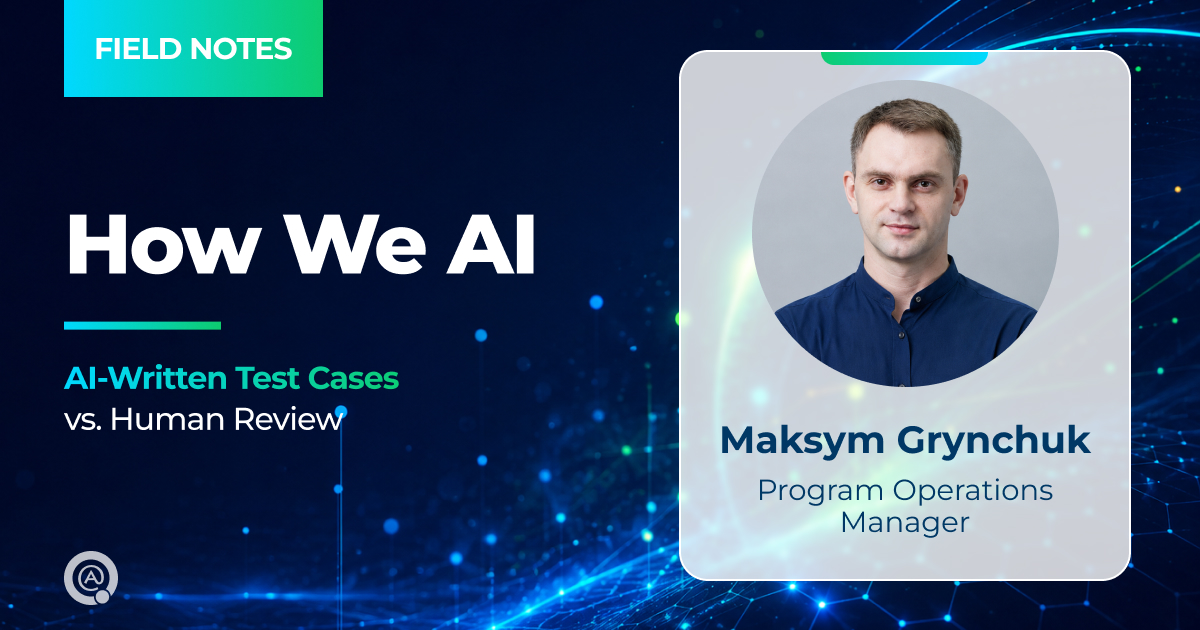
How We AI: AI-Written Test Cases vs. Human Review
Give an AI tool a clear requirement, and within a minute, you can get a structured draft with preconditions, steps, and expected results. A year ago, that felt impressive. Today, for teams already using AI in QA workflows, it feels closer to a basic starting point.
Across our projects, the question I keep returning to is how that output moves through the actual QA process. Who reviews it? What context is added? Which cases are useful enough to keep? And where does the team still need to apply product knowledge, release history, and risk judgment before adding a test case to the working suite?
So, this digest is my view on where AI earns its place in test case writing, where human review stays essential, and how teams can structure the handoff between them.
AI-Written Test Cases: The Starting Point
When teams use AI for test case writing, the first result usually looks like a familiar QA artifact: a title, preconditions, test steps, expected results, and sometimes a few positive, negative, or boundary scenarios.
That structure matters. A test case is usually built around a specific objective or test condition and includes the conditions, inputs, actions, and expected outcomes needed to verify it. AI can follow this format quickly when it receives a requirement, user story, or acceptance criteria as input.
For example, if the requirement says that a user should be able to reset a password, AI can quickly turn it into a basic test case draft:
- Open the reset password page.
- Enter a registered email address.
- Request a reset link.
- Open the link from the email.
- Create a new password.
- Log in with the updated credentials.
It can also generate adjacent scenarios from the same requirement, such as an unregistered email, an expired reset link, a weak password, or multiple reset requests.
At this stage, AI-written test cases are best treated as an early draft of possible coverage. They help move the work from raw requirement text to something the QA team can evaluate inside the actual testing process.
The Context Pack: What AI Needs Before Drafting
Before AI generates test cases, the quality of the input matters almost as much as the tool itself. A short requirement can produce a clean-looking draft, but the result will usually stay close to the information provided. If important context is missing at the start, it often returns later as rewriting, clarification, or cleanup.
That is why I prefer treating AI input as a small context pack. It does not need to be long, but it should give enough direction for the draft to be useful in a real QA workflow.
What goes into the pack
Seven pieces of context that consistently improve what AI produces.
For example, the prompt “write test cases for password reset” may produce a basic flow. A stronger input would include user roles, password policy, email delivery behavior, link expiration rules, supported platforms, localization requirements, and known issues from previous releases.
If the expected behavior is still unclear, the first step should be clarification rather than generation. AI can structure a well-defined problem, but any missing acceptance criteria or unstable business rules should be resolved before drafting begins.
With that context in place, the next question is what AI drafting can do well — and where the output still needs control.
AI Drafting: Strengths and Limits
AI drafting earns its place when the team needs to move quickly from a requirement to an early version of test coverage. At the same time, the same draft can carry weak spots that only become visible during review. To use AI well in test case writing, it helps to see both sides clearly.
Where AI Drafting Is Strong
When the input is clear, AI turns requirements, user stories, or acceptance criteria into structured drafts faster than the team would usually prepare them manually. In practice, I see three areas where this helps most:
- Speed: AI reduces the empty-page stage, giving the team an early draft to review.
- Structure: it can follow a requested format, such as step-based test cases, tables, Gherkin-style scenarios (Given/When/Then), or grouped test ideas.
- Scenario expansion: from one requirement, it can suggest happy paths, invalid inputs, missing data, boundary values, repeated actions, or basic error states.
For teams working under release pressure, this makes the first review more efficient because there is already something visible to accept, adjust, or remove.
Where AI Drafting Needs Control
Even a well-structured draft can stay disconnected from the real product. AI may follow the wording of a requirement correctly, while still missing what makes a test case useful in a real QA process. This usually happens when the requirement is too narrow, too isolated, or too far removed from the actual product environment.
Where AI drafting needs control
Even with a good context pack, three patterns show up in almost every draft. Knowing them upfront makes review faster.
| Risk area | What can happen in the AI draft |
|---|---|
| Context gaps | The case may miss integrations, permissions, environments, previous defects, or business-critical paths. |
| Too much volume | The output may include many cases, but with duplicated checks, low-value scenarios, or unclear priorities. |
| Generic logic | The case may include a title, steps, and expected results, yet remain too abstract for execution. |
For example, a test case with the expected result “user receives an error message” may look acceptable at first glance. In practice, the team may still need to define the exact role, data state, platform, localization, integration response, and recovery path.
The real risk appears when generated cases move forward without enough selection, context, or priority.
Human Review: Context, Risk, and Judgment
Once the AI draft exists, the work shifts from generation to evaluation. The team needs to decide whether the case reflects the real product, the current release scope, and the risks that matter before shipping.
A requirement can describe expected behavior, but a review adds the context that usually lives outside the draft: release history, recent changes, known weak points, and potential user or business impact.
This is where review becomes more than editing. The team decides whether the draft is relevant enough to move forward and what kind of refinement it needs. Some cases may be technically valid, but still not useful enough for the current release. Others may look simple, but protect a critical user path or an area with a history of defects.
For me, this is where a structured draft becomes a QA decision. A strong test case should make it clear what is being checked, which risk it covers, and why it matters now.
The Handoff: How AI Output Becomes a QA Decision
The previous sections describe what AI prepares and what the team adds. The harder question in daily work is what happens between those two stages — how a draft actually moves from generated text to an approved test case in the suite.
In practice, I see the handoff as four steps the team applies to every AI batch:
How the team turns an AI draft into a test case
Four moves the reviewer makes before the case enters the suite. Each one adds something the model couldn’t.
Decide which cases belong to the current release scope and which are out of scope or low value.
Add roles, environments, data states, integration responses, and other details that the requirement did not include.
Connect each remaining case to user impact, business impact, compliance, security, or support load.
Align titles, preconditions, steps, and expected results with the team’s test design standards before the case enters the suite.
When this handoff is skipped, the suite grows faster than the team’s confidence in it. When it works, the AI draft stops being a separate artifact and becomes part of the team’s coverage decision.
The Practical Bottom Line
AI can speed up test case drafting, but a generated draft still needs to earn its place in the suite. It should reflect the product, connect to the current release, cover a meaningful risk, and support the team’s confidence before shipping.
For me, this is where AI fits best: it helps the team start faster, while people keep ownership over relevance, priority, and final coverage.
Want to make your test coverage more reliable before release? We can help assess your QA process, identify coverage gaps, and define a practical testing approach for your product. Book a discovery call to discuss where QA can bring the most value.
FAQ
Learn more from QATestLab


Related Posts:
About Article Author
view more articles