Managed Game Testing: Keep Your QA Stable During Summer Vacations
Managed game testing is a model in which a studio delegates its QA process to an external partner for a defined period, such as summer vacations. The goal is to keep test coverage, regression cycles, and platform submissions on track while in-house engineers are away.
Summer vacations often reduce QA capacity right when live-service updates, seasonal events, and platform submissions still need stable testing. A managed QA team helps cover that gap with dedicated testers, structured reporting, and a clean handoff process, so release quality stays protected without adding pressure to the team that remains online.
Below, we break down how managed game testing works, where summer QA risks usually appear, what mistakes studios should avoid, and how to prepare your project for a smooth external QA handoff.
What Is Managed Testing for Games?
Managed game testing is a model where a studio delegates its QA process to an external partner for a defined period. You hand over scope, priorities, and access to the build. The partner assembles a team, runs test cycles, tracks defects, and delivers structured reports with reproduction steps and severity ratings. Your involvement focuses on setting goals and reviewing outcomes, while the QA partner manages the team day-to-day.
The partner selects testers based on your project’s genre, platform, and technical requirements. A mobile puzzle game, for example, needs specialists who understand device-specific testing and casual player flows. A PC multiplayer shooter requires testers with experience in network latency, online sessions, and competitive balance.
For studios with limited internal capacity, managed testing works as a structured QA outsourcing model that keeps coverage, reporting, and release checks active without overloading the in-house team.
How Does Managed Game Testing Work?
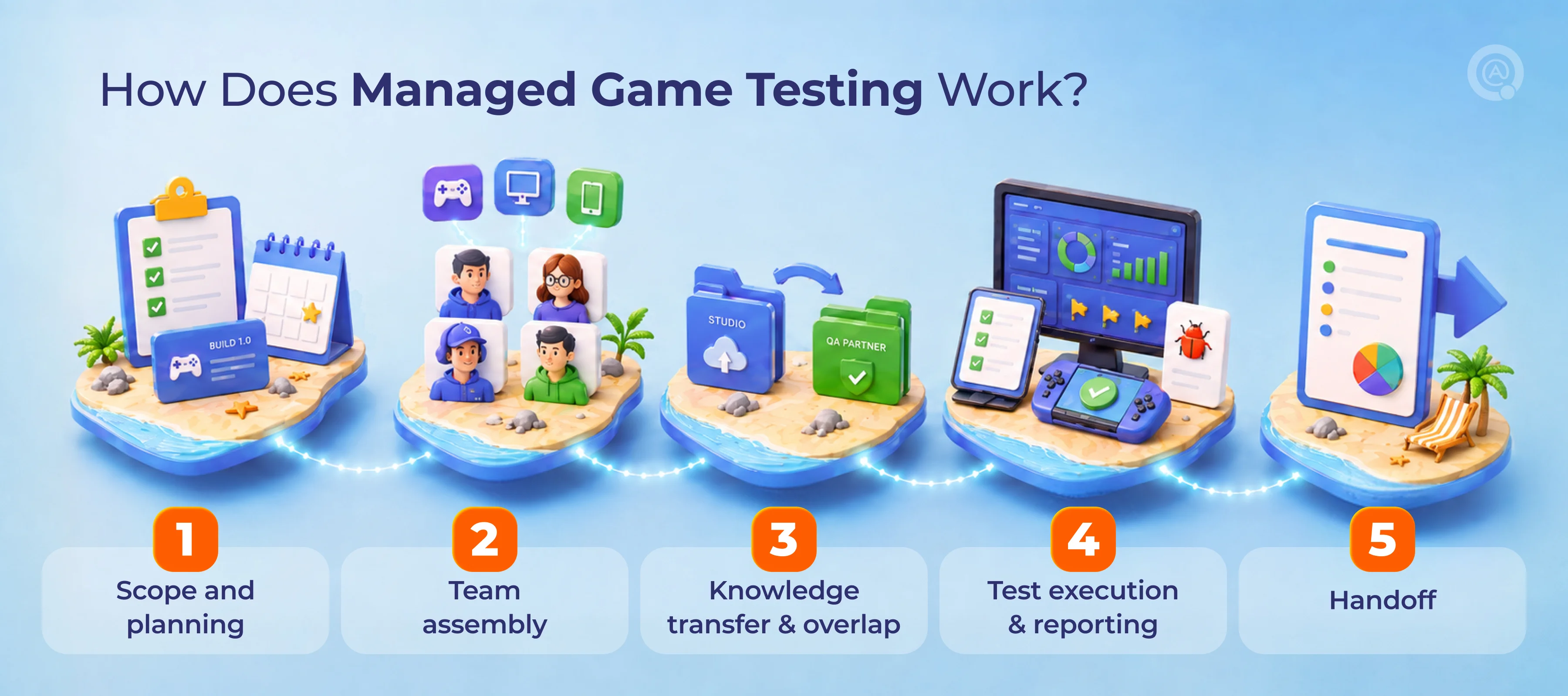
Most game studios go through five stages when working with an external QA partner.
- Scope and planning. The QA partner reviews your game build, test cases, defect backlog, platform targets, and upcoming milestones such as content drops or store submissions. The result is a testing plan tailored to your release cadence.
- Team assembly. The partner assigns testers with relevant experience in the genre and platform. The team size and composition depend on your project scope, testing priorities, and the duration of the engagement.
- Knowledge transfer and overlap. Before your in-house team leaves, both teams run test cycles in parallel. The external testers learn the build pipeline, test environments, known issues, and platform-specific quirks. This overlap prevents blind spots after the handoff.
- Test execution and reporting. The managed team runs daily cycles: regression testing on the latest build, new-feature verification, compatibility passes, and exploratory sessions. You receive reports with defect counts, platform-specific breakdowns, and risk flags tied to your release dates.
- Handoff. When your team returns, the partner delivers a transition document that includes open defects by severity and platform, coverage metrics, areas needing attention, and recommendations for the next sprint. If a critical blocker surfaces during the handoff week, the external team continues working on it until your engineers confirm they have full context and can take over.
How Summer Vacations Affect Game Release Cycles
QA is one of the leanest functions in most game studios. When two or three engineers take time off simultaneously, the remaining team rarely has sufficient capacity to maintain stable coverage across all active builds and platforms.
Live-service games with seasonal content, battle passes, and weekly events ship updates on a fixed cadence. Missing a testing cycle means pushing an untested build to production or delaying the content drop. Both outcomes hurt revenue and erode player trust. For studios on a tight cadence, scaling coverage through game testing services during peak vacation weeks is often the only way to keep the release calendar intact.
Platform submissions to Sony, Microsoft, and Nintendo follow strict timelines. When a build fails certification, the platform holder issues a report of fixes required before resubmission. That cycle pushes the launch window back — Microsoft’s certification guidelines [1] describe this process in detail. Summer submissions are especially common because many studios aim for Q3 and Q4 release dates, ahead of the holiday sales peak.
The cost of these gaps adds up fast. A platform submission sent without full regression fails certification and pushes the release back by weeks — something we see regularly and cover in detail in our compliance testing guide. A live-service update that goes out with missed defects can spike refunds and damage player retention. For studios running on a summer skeleton crew, even one bad build can turn a manageable vacation period into a recovery project.
Common Mistakes Studios Make With Summer QA
Starting the search in July
The most common mistake is treating QA coverage as a last-minute problem. By the time a studio reaches out to a testing partner in early July, vacations have already started. Onboarding an external team without overlap means the new testers learn the project blind, with no internal engineers available to answer questions.
No knowledge transfer before departure
Even when studios plan ahead, some skip the knowledge transfer step. They hand the external team a build and a JIRA board and expect results. Without a walkthrough of the test environments, known issues, build quirks, and release priorities, external testers spend their first week figuring out things your team already knows.
Relying on a single freelancer
Hiring one freelance tester to cover for three engineers looks cost-effective on paper, but the math rarely works out. One person cannot maintain the same test coverage, and when that person gets sick or takes a day off, coverage drops to zero.
Assuming QA can pause and resume
Some studios decide to stop testing during vacations and resume when the team returns. This creates a backlog of untested builds that takes weeks to clear. Defects introduced during the gap period stack up, and the returning team faces a codebase they no longer trust.
Not defining escalation contacts
If a problem arises while the core team is on vacation and no one is designated to make a decision, the external QA team cannot move forward. Every summer engagement needs a clear escalation path, even if the contact person is on vacation and only checks messages once a day.
Managed QA vs Freelancer vs Pausing QA
When in-house QA engineers go on vacation, studios typically choose between three options: hiring a managed QA team, bringing in a single freelancer, or pausing testing until the team returns. Each option differs in coverage depth, ramp-up speed, risk tolerance, and cost, so the right choice depends on your release schedule and the level of risk your project can absorb during the gap.
Keep your QA stable during summer vacations
Three ways to handle game testing while your team is away — and how they compare.
| Criteria | Managed QA team | Single freelancer | Pausing QA |
|---|---|---|---|
| Test coverage | Full coverage across all platforms, devices, and test types. Team size matches project scope | Partial coverage. One person cannot run regression, compatibility, and exploratory testing simultaneously | Zero coverage. Untested builds accumulate until the team returns |
| Knowledge transfer | Structured onboarding with a one-week overlap. The partner’s PM or Tech Lead manages the process | Informal ramp-up. Depends on one person’s speed and your documentation quality | No ramp-up needed, but the returning team faces a backlog of untested builds and lost context |
| Risk if unavailable | The partner rotates or replaces testers. Coverage stays stable | If the freelancer is sick or unavailable, coverage drops to zero | Coverage is already zero |
| Reporting | Daily structured reports with defect counts, severity ratings, platform breakdowns, and risk flags | Reports depend on the individual’s process. Quality varies | No reports. Defects remain undiscovered until the team returns |
| Cost structure | Fixed engagement fee based on scope and duration. Predictable | Lower daily rate, but hidden costs from gaps in coverage and potential rework | No direct cost, but high risk of delayed releases, failed certifications, and post-release defects |
How to Prepare Your Project for an External QA Team
At QATestLab, we recommend preparing these items before the external QA team joins the project. The smoother this prep, the faster any game testing services engagement reaches full coverage.
- Up-to-date test documentation. The external team needs critical test cases, a regression suite, gameplay flow notes, environment setup instructions, and platform-specific requirements. For games, this includes core mechanics, progression, save/load behavior, monetization flows, multiplayer scenarios, and certification checks.
- Stable build access. The external team should be able to access the latest game build without having to ask your developers for help. If your build process requires manual steps, test accounts, launch parameters, VPN access, or specific branches, document these details before the vacation begins.
- Tool access. Create accounts for the external testers in your project management, defect tracking, and test management tools. Pre-configure permissions so the team can log defects, attach screenshots and videos, update test cases, and access builds from day one.
- Communication channel. Set up a dedicated Slack or Teams channel for the external QA team. Define response time expectations, daily update format, bug triage rules, and escalation contacts for crashes, blockers, payment issues, or platform-specific risks.
- A list of known issues. Share the current list of known issues before the handoff. Include affected platforms, devices, game modes, severity, workarounds, and current status so the managed QA team can focus on new defects.
- Designated internal contact. Even if your QA lead is on vacation, someone on the studio side should be reachable for critical decisions. This can be a producer, project manager, developer, build engineer, or game designer.
- A one-week overlap. Plan for the external team to start while at least one internal QA engineer or project owner is still available. During this week, both teams align on the build pipeline, gameplay priorities, known weak points, reporting format, and defect severity.
What a Managed QA Team Usually Covers
The scope of a managed testing engagement depends on the project, but most game studios include a combination of the following testing activities.
Functional testing
The team verifies core gameplay, UI logic, progression, purchases, achievements, and save/load behavior. This helps protect the player experience and prevents critical flows from breaking in a live build.
Regression testing
After each update, the team checks that new changes have not broken existing functionality. During summer, this helps keep the release cadence stable even when internal QA capacity is reduced.
Compatibility testing
The team checks how the game performs across target devices, OS versions, hardware configurations, and platforms. This reduces the risk of device-specific crashes, poor performance, failed submissions, and negative player reviews.
Performance testing
The team monitors load times, frame rate stability, memory usage, crash rates, server behavior, and network latency. This helps protect retention, especially for live-service and multiplayer games where instability quickly affects player trust.
Localization testing
The team verifies text fit, translation accuracy, cultural context, and regional formats such as dates, currencies, and UI labels. This helps avoid confusing user experiences, broken interfaces, and quality issues in target markets.
Usability and exploratory testing
Experienced game testers play the build as real users would, looking for issues that scripted test cases may miss. This helps identify confusing flows, unclear tutorials, difficulty spikes, and interaction problems before they reach players.
The right testing scope should protect the parts of the release that carry the highest business risk. Some projects need stronger certification and compatibility coverage. Others need stable regression, performance, and live-service update testing to protect player experience, release cadence, and revenue during the vacation period.
How QATestLab Handles Summer QA
At QATestLab, summer managed QA starts with a clear handoff plan. Before testing begins, we review the release calendar, target platforms, build access, current defect backlog, documentation, and vacation timeline. This helps define what needs to be covered, where the main risks are, and how much overlap is needed before the in-house team becomes unavailable.
Depending on the studio’s setup, the engagement can be led by a QA Project Manager or a QA Tech Lead. A QA Project Manager coordinates the process, manages communication, tracks progress against release milestones, escalates blockers, and keeps reporting consistent. A QA Tech Lead guides the team from a technical perspective, reviews test documentation, defines testing priorities, and provides recommendations on coverage, tooling, automation, and risk areas.
The QA team is selected based on the game’s genre, platforms, product complexity, and release goals. The team works inside the studio’s existing workflow whenever possible, using the same defect tracker, test management tools, communication channels, and reporting format. This keeps the process transparent and makes the final handoff easier when the in-house team returns.
This approach is reflected in our recent summer release stability case study for a live-service mobile game. During a period of reduced internal QA capacity, the release cycle continued without interruption, full test coverage was maintained across active updates, and the team completed the engagement with zero critical production issues.
Checklist: Is Your Studio Ready for Managed Summer QA?
Before you engage an external QA partner for the summer, review the points below. The more statements that match your situation, the stronger the case for managed testing. Studios where six or more points apply typically benefit most from external QA coverage during the vacation period.
Is your studio ready for summer QA?
A quick self-check before the vacation season.Six or more boxes ticked? A managed QA team will likely keep your summer releases on track.
Summary
Managed game testing solves a specific, predictable problem: your QA team goes on vacation while your project still needs regression cycles, platform submissions, and defect tracking to continue without interruption.
The studios that get through the vacation period without shipping known defects or delaying releases are the ones that scope the work early, prepare documentation before departure, and bring in an external QA team with enough overlap for a clean handoff. When the engagement ends, your returning engineers inherit a tested codebase, a current defect log, and no backlog.
If your studio is facing overlapping vacations, a summer submission deadline, or a live-service game that cannot pause updates, the time to start is now — not in July when coverage is already gone.
Ready to discuss managed QA for this summer? Contact QATestLab to scope the engagement, define the handoff timeline, and get your project covered before the peak vacation weeks hit.

FAQ
References & Further Reading
- Microsoft, “Xbox Game Certification Guide,” Microsoft Game Development Kit documentation. https://learn.microsoft.com/en-us/gaming/game-publishing/concepts/certification/certification-guide
Learn more from QATestLab


Related Posts:
About Article Author
view more articles