Wellness Apps: 5 Quality Obstacles and How To Overcome Them
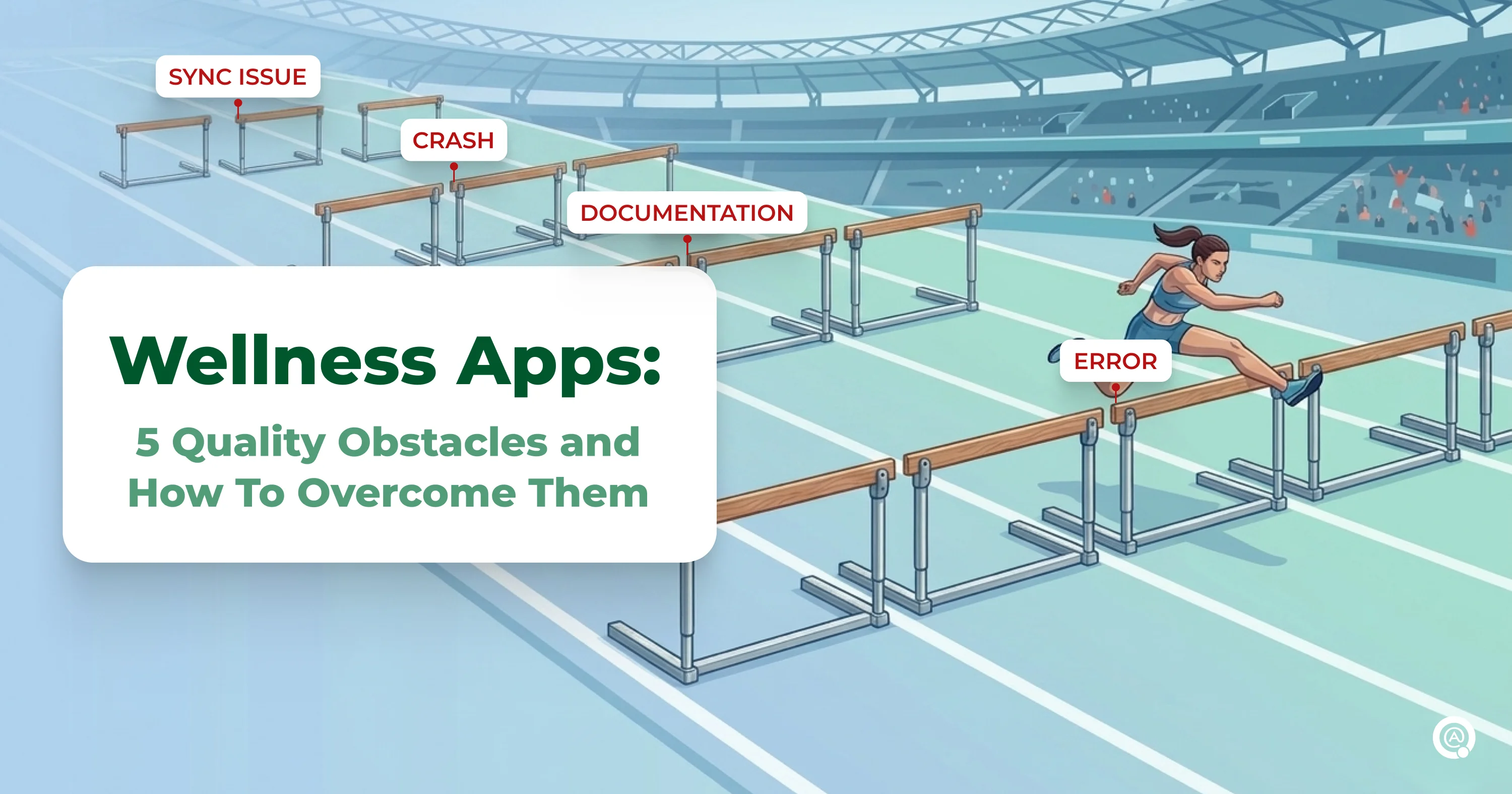
Wellness apps are integral to self-care. People use them to track workouts, count steps, monitor heart rate, and track data about their bodies. That is a high level of trust, which makes error tolerance much lower than in most app categories. A lost step count or a crash mid-exercise feels personal.
Testing Wellness Apps: The Basics
Wellness app testing is a continuous process that covers frequent updates, wearable integrations, compatibility with hundreds of device combinations, and other quality needs for fitness and health-tracking products. The goal is to make sure the app stays accurate and reliable at every point where a user depends on it.
We’ve built QA processes for multiple wellness platforms, from a global fitness ecosystem with 200M+ installs across multiple products to a small bootstrapped startup aiming to build stable integrations with Apple Health and Google Fit. In this article, we share five challenges that were most common for each project and what QA practices need to be in place to ensure users enjoy the app.
Release + Testing Synchronization
Retention rate is one of the key stats for wellness platforms. The numbers are quite low for the niche: day 1 retention is roughly 23% on average, while by day 30 it drops to 3-10% [1]. Every update that improves onboarding or fixes a friction point can affect whether users stay past week one.
To keep users engaged, teams roll out frequent updates: new workout plans, UI improvements, A/B experiments, bug fixes. Some teams push updates daily, others ship several times a week while running parallel work on new modules.
This pace creates tension: every build needs testing before it reaches users, but when changes ship several times a week, your regression suite grows faster than your test windows allow. Teams end up spending more time reacting than planning, and a Monday hotfix can quietly break something that worked on Friday. By the time the issue surfaces, it’s already in the App Store reviews.
A structured QA process would allow you to protect users from unexpected issues:
Keeping releases controlled
- Build a prioritization framework that ranks test coverage by user impact: core tracking flows first, then payments, then secondary features
- Introduce a documented release scheme with roadmaps and release notes visible to QA, dev, and product
- Replace ad-hoc communication with daily syncs between QA, developers, and product managers
- Scale your test case library to match product complexity (across our wellness projects, this meant 400–600+ test cases per platform)
Preventing Blind Spots in Wellness Apps
Another issue caused by the high delivery pace is that teams build faster than they document. A new workout tracking mode goes live, but nobody wrote acceptance criteria for it. A health metric calculation changes, but the logic lives in a developer’s head, not on a wiki page.
For a QA team, this means testing blind. You can verify that a button works, but you can’t confirm the feature matches its intent without a spec. New team members spend weeks piecing together product logic from old tickets and hallway conversations. This also causes missed edge cases, as nobody mapped the boundaries.
These practices will prevent the miscommunication-caused issues from reaching the users:
Closing the documentation gap
- Make documentation a release gate: if a feature isn’t documented, it’s not ready for testing
- Have QA create test documentation before releases, turning implicit product knowledge into written specs
- Build a shared knowledge base (Confluence or similar) and a structured test case library (TestRail or equivalent)
- Maintain release notes and product roadmaps that keep all teams working from the same reference point
Dealing With Integrations
A wellness app syncs step counts with Apple Health, pulls heart rate data from Google Fit, and connects to Apple Watch, Fitbit, or Garmin. Each integration has its own API, its own permission model, and its own behavior when the app runs in the background versus the foreground.
The failures here are subtle and often platform-specific. A user switches from Samsung Health to Google Fit and loses 300 steps on the identical stroll because Google Fit calculates stride data differently. HealthKit syncs fine on iPhone 15 but skips data on iPhone 12 running an older iOS. A wearable disconnects mid-workout, and the app doesn’t pull the data during sync.
Every integration adds another risk zone where users stumble into issues. This is why it’s important to:
Testing integrations without blind spots
- Build API collections that validate backend data exchange with each health platform separately
- Run integration testing as a dedicated track with its own coverage plan, separate from functional testing
- Simulate real user workflows in production-like environments: actual workout scenarios with connected devices
- Test platform-switching scenarios (e.g. migrating from Samsung Health to Google Fit) as first-class test cases
Taming the Fragmentation
Two platforms with multiple OS versions. Dozens of phone models. Add wearables, and you’re looking at hundreds of device-OS-accessory combinations. A layout that renders fine on Pixel 8 may clip on Samsung Galaxy A14. A background tracking service that runs on iOS 17 may be shut by battery optimization on Xiaomi.
These differences carry over into how each device handles background activity. For example, a user starts a workout, switches to a music app, and when the training ends, finds out the session dropped because the OS reclaimed resources. That’s a frustration that ruins the experience.
Users carry mid-range phones, run various OS platforms, and pair budget wearables. Your device coverage should reflect that:
Covering real-world device diversity
- Build a device matrix that includes mid-range phones, older OS versions, and popular wearable pairings
- Test cross-platform compatibility for both functional parity and platform-specific behavior
- Run multitasking as a separate test focus: start session, switch apps, return, verify data integrity
When Stability Meets Real World
Wellness apps run in real time, which makes stability a direct factor in the customer experience. According to the research by Luciq, there is a clear correlation between app store ratings and crash-free session rates. Apps that fall below a 99.7% crash-free threshold struggle to reach even a 3-star rating, while achieving 4.5+ stars requires at least 99.85%[2].
Seasonality also adds load that you can’t predict from dev metrics alone. January brings a spike from New Year’s resolutions. Summer drives outdoor fitness engagement. Marketing campaigns create surges on short notice. Memory usage and response times that look fine in staging buckle under production traffic.
For a fitness app where crashes happen during active workouts, the reputational cost is higher. Make sure every workout runs smoothly:
Catching performance issues before users do
- Run stress tests that replicate real usage: long sessions, concurrent syncs, multiple background services
- Use smoke testing as a first filter on each build before deeper test cycles begin
- Have a QA architect review the app’s architecture for scalability bottlenecks, especially before high-traffic seasons
- Catch crashes and slow-loading screens in staging, not in the App Store
FAQ on Testing Wellness Apps
What Makes Wellness Apps Trustworthy
Wellness apps are part of daily health routines for many. Users open them before a workout, check them after a walk, trust them with data about their body. That closeness creates a lower tolerance for errors than most app categories face. A lost step count or a broken sync feels like the app doesn’t care about the person using it.
Quality assurance for this kind of product means matching the speed and complexity of a platform that ships daily, integrates with multiple external services, and holds data that users consider part of their wellbeing.
We’ve built these processes across several wellness apps. If you’re working through similar challenges, reach us, we know what to do.

Learn more from QATestLab


Related Posts:
About Article Author
view more articles