What Happens When GenAI Meets IoT? Trends You Need To Know
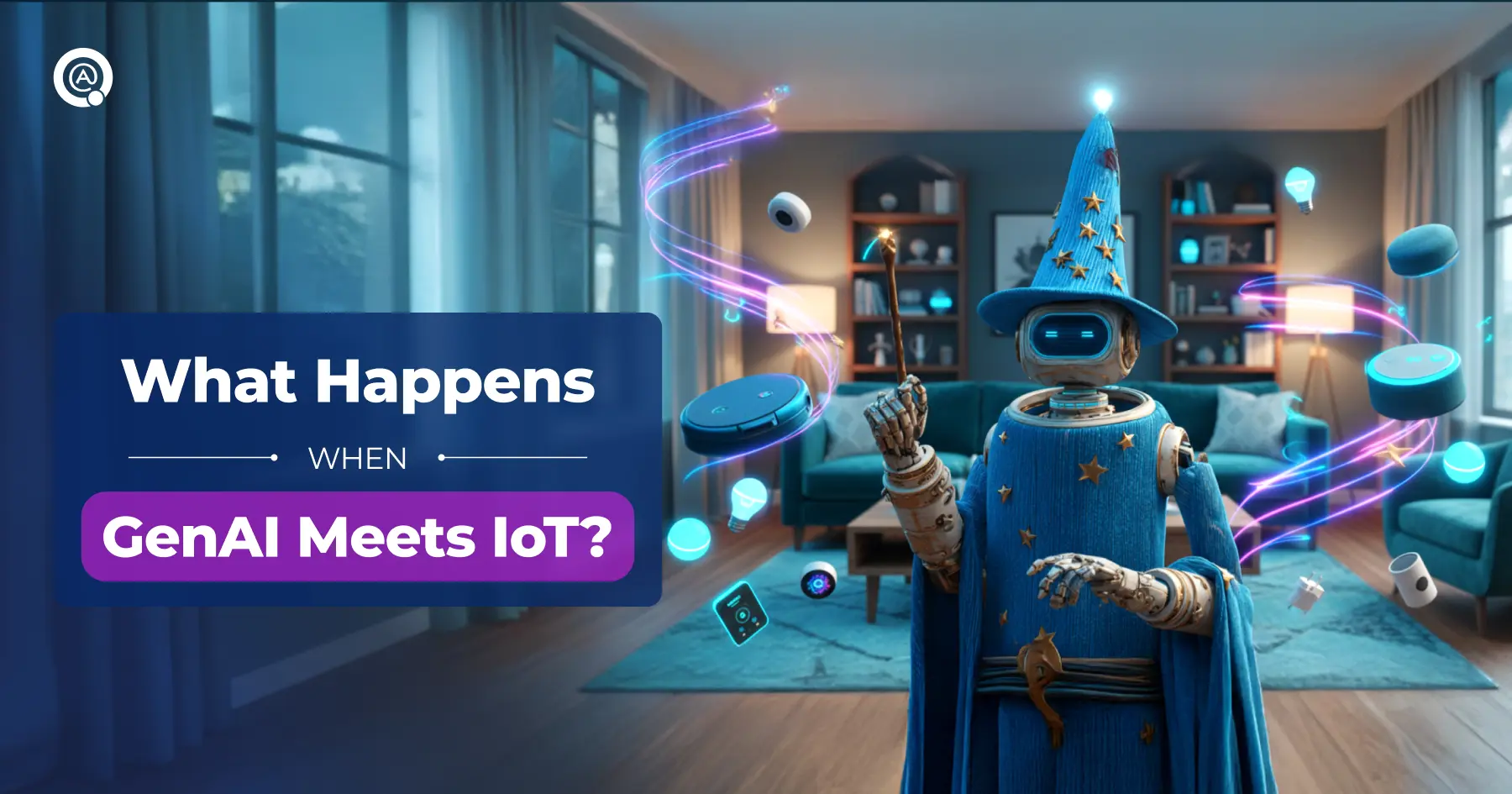
Recently, Google announced a significant update to its Nest lineup, integrating its Gemini AI models directly into home devices. This moves us from basic command-and-control interactions (e.g., “Hey Google, turn on the lights”) to a conversational, context-aware IoT experience. Instead of a generic “motion detected” alert, users now receive detailed insights, such as “dog jumping on the couch”.
For business decision-makers in IoT, this signal is clear: static smart devices soon will be history. The market now demands devices that don’t just connect, but understand. This transition brings new technical trends and, inevitably, new challenges in quality assurance.
The Usual Suspect: AI
Generative AI and Natural Interfaces
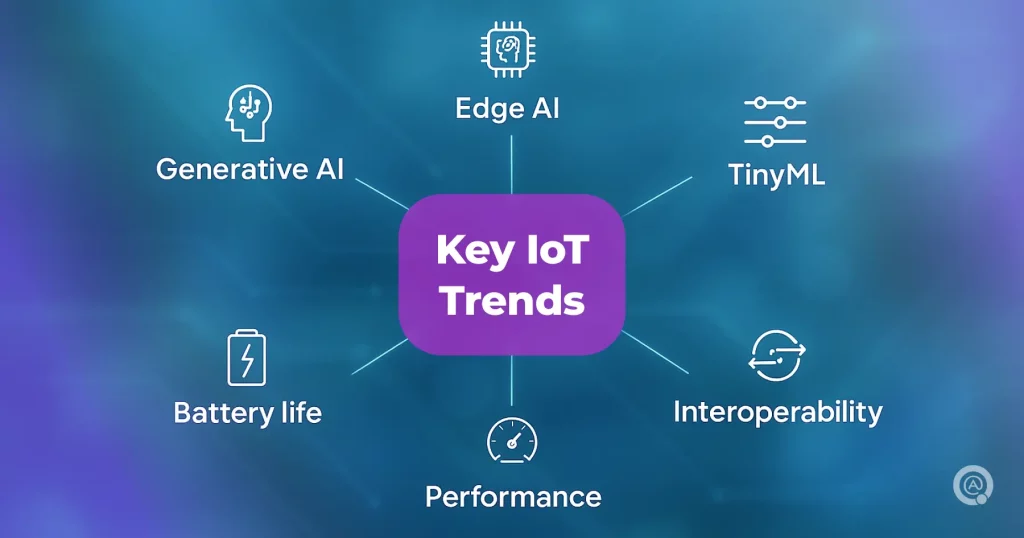
Google’s update highlights the adoption of Generative AI in IoT. We are moving from rigid, pre-programmed responses to fluid, natural interactions. This includes Social IoT, where devices can handle complex dialogue, enabling the system to act as a personal assistant to the user.
QA Perspective: Testing the Unpredictable
Generative models are non-deterministic and rarely give the same answer twice. This is why your main QA challenge would be to prevent hallucinations or incorrect actions when a user gives a vague command.
⮑Testing here requires a shift from simple “pass/fail” scripts to semantic evaluation. You need to verify that the device’s interpretation of natural language aligns with the user’s intent across a wide variety of phrasing variations.
IoT Shift to Edge AI and TinyML
The cloud-first approach is changing towards local processing. This allows devices to analyze data and react instantly, without the delay of sending it to a remote server.
Distributed Computing
Transferring raw data to the cloud introduces latency and eats up bandwidth. The industry is shifting toward Edge AI, where data processing happens locally on the device or a nearby gateway. This is a critical shift for systems that can’t afford delays, such as self-driving cars and industrial robotics.
Tiny Machine Learning
This is the art of running ML models on hardware with limited resources, like microcontrollers (MCUs). With model compression techniques like Neural Network Quantization, companies can deploy smart features on devices with minimal power and memory.
QA Perspective: Performance Balancing
The main challenge here is the trade-off between intelligence and efficiency. When optimizing models for small chips (e.g., reducing precision to 8-bit integers), ensure that the accuracy doesn’t drop to unacceptable levels.
⮑QA teams should put their backs into performance testing to verify that efficiency gains do not degrade the user experience or the model’s decision-making accuracy.
Other Vital IoT Trends to Watch
While AI grabs the headlines, the foundational infrastructure of IoT is also shifting.
Interoperability and Matter
You no longer need to stick to one brand for everything to work together. The industry is adopting universal standards like Matter, which lets your Google Nest Hub control a smart bulb from any other brand seamlessly. This same shift is happening in factories, where different machines and computer systems are finally learning to “speak the same language”, breaking down old barriers to data sharing.
QA Perspective: The Compatibility Matrix
This makes it crucial to ensure that your device can reliably communicate with products from five other vendors.
⮑Interoperability is non-negotiable. Verify that your device functions correctly across a matrix of different hubs, OS versions, and adjoining products. Relying on simulators won’t be enough.
Low-Power Design
This is one of the continuous challenges – as devices get smarter, they consume more power. This makes the industry lean toward ultra-low-power components and optimized protocols (like BLE and LoRaWAN) to ensure sustainable operation.
QA Perspective: Battery Life in Mind
Battery life is crucial like never before, and one key question now is whether the new features drain the battery in half the time.
⮑Monitor power consumption under various network conditions to ensure the device remains usable for its intended lifespan.
IoT Complexity vs. Consistency
These trends create a perfect storm of challenges. Delivering a competitive product now requires orchestrating the entire ecosystem of AI models, cloud integrations, and strict privacy regulations like the EU Data Act.
The risk of releasing a flawed product is higher than ever. And a single failure in data integrity or a connectivity drop can ruin the trust you’ve built up.
How QATestLab Can Solve This
The industry changes may seem too radical, but you don’t need to rebuild your QA team to keep up with quality demands. QATestLab can join your team immediately to cover gaps, saving you the overhead. What we bring to the table:
- Testing on real devices to ensure true compatibility across different brands and protocols. This includes using an internal pool with 500+ gadgets, as well as any specific devices you ship to us.
- End-to-end connectivity as we verify the entire chain from the sensor to the edge gateway, cloud, and user app, ensuring data integrity even when the network is unstable.
- Usability and performance testing, including response times and real-world battery usage, to ensure that smart features actually feel smart.
Let us handle the testing complexities, so you can focus on driving innovation. Learn more about our services at the dedicated page.
FAQ: Quick Market Insights
Q: What is the biggest risk with Edge AI?
A: The trade-off between accuracy and power. Running heavy models on small chips can drain batteries or lead to poor decision-making if the model is too compressed.
Q: Why are standards like Matter important for my business?
A: It reduces development overhead. Instead of building custom integrations for HomeKit, Alexa, and Google Home, you build once for Matter, and it works everywhere.
Q: How does Generative AI change IoT development?
A: It speeds it up. GenAI can help generate code for device control, but it requires strict oversight to ensure the generated code is efficient and bug-free.
Ride the Tide Without Failure
The integration of Gemini into Google Home is just one example of a broader industry shift. AI is making IoT devices more capable, but also more complex. To stay relevant, businesses embrace Edge AI, prioritize interoperability, and ensure their products are robust enough to handle the real world.
But without reliability, any innovation is an empty promise to the users. Precise QA that covers real devices, connectivity, and AI performance will help you ensure your product is ready for the smart home of tomorrow.
Ensure your IoT solution is market-ready. Contact us to discuss your current testing approach and how we can help.

Learn more from QATestLab


Related Posts:
About Article Author
view more articles