When Bugs Tank Your Rankings: How QA Testing Drives SEO Performance
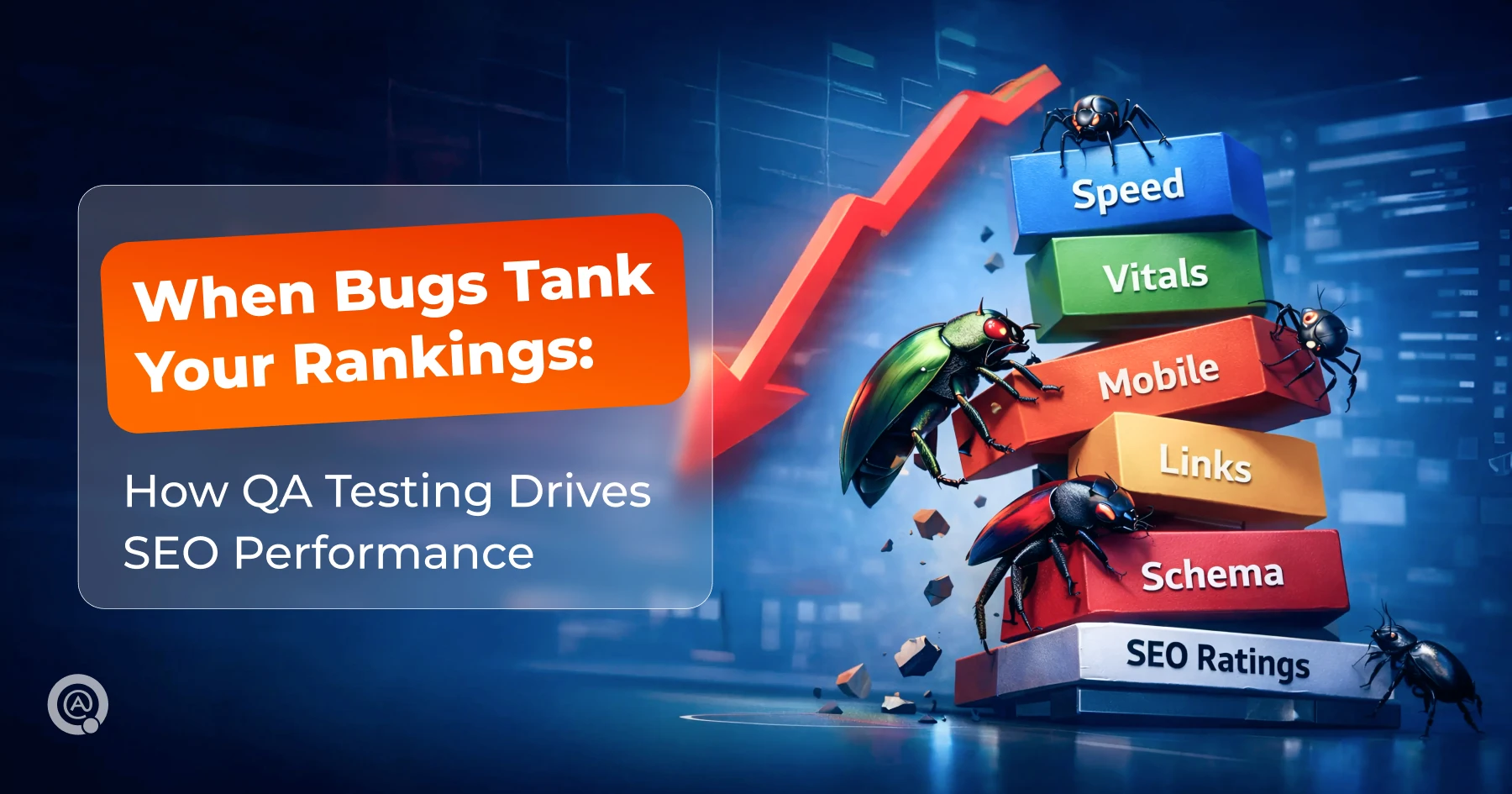
You can invest thousands of dollars in content marketing and link-building campaigns, but if your website is slow or unstable, Google will quietly push it down in search results. In many teams, marketing and QA operate in parallel rather than together — and this disconnect often costs companies traffic, conversions, and revenue.
Software testing for SEO plays a much larger role in search performance than it is usually given credit for. By validating performance, stability, and real user experience, QA helps ensure that a website meets both user expectations and search engine requirements.
Why Site Speed Is a Ranking Factor — And How QA Fixes It
Site speed affects rankings because it directly shapes user behavior (bounce rate, session depth) and signals technical quality to search engines. QA fixes this through site speed optimization — identifying and removing performance bottlenecks that slow pages in real-world conditions, before they affect traffic, through measurable load-time reduction.
Google research shows that 53% of mobile visitors abandon a site if it takes longer than 3 seconds to load. As load time increases from 1 to 3 seconds, bounce rates grow by 32%. Pages that take 5 seconds or more can see bounce rates approach 90%.
Performance testing services help teams address these issues before they affect rankings. Through load and stress testing, QA engineers identify server-side bottlenecks, inefficient APIs, and traffic-related breaking points that slow the site down under real conditions.
Tools such as JMeter and Google Lighthouse allow QA teams to analyze performance far beyond what standard SEO tools provide. They expose such problems as render-blocking JavaScript, oversized media assets, slow server responses, and inefficient frontend rendering — all of which directly affect both user experience and search visibility.

Core Web Vitals — Where QA and SEO Intersect
Core Web Vitals are Google’s primary metrics for measuring real user experience. This matters for rankings because CWV translate “technical quality” into measurable signals Google can evaluate at scale. QA helps by validating the exact conditions that push these metrics into the green zone — Core Web Vitals optimization in practice.
To meet Google’s requirements, a site must achieve “good” scores across these metrics for at least 75% of real user visits.
- Largest Contentful Paint (LCP) reflects how quickly the main content becomes visible. Google recommends keeping LCP under 2.5 seconds. In practice, this metric captures whether users see meaningful content fast enough to stay engaged. Performance testing helps optimize server response times, media delivery, and resource prioritization — all of which directly influence this metric.
- Interaction to Next Paint (INP), which replaced First Input Delay in 2024, measures how responsive a page feels during user interactions. In other words, it reflects how quickly the interface responds to user taps, clicks, or typing. QA testing ensures that scripts execute efficiently and that interface responses remain smooth and predictable. Poor responsiveness frustrates users and can correlate with weaker engagement signals.
- Cumulative Layout Shift (CLS) measures visual stability and should remain below 0.1. This metric captures “content jumps” during load that lead to misclicks and frustration. Visual and UI regression testing prevents unexpected layout shift issues that cause accidental clicks, disrupt reading, and degrade user trust — behaviors Google tends to interpret as lower-quality experience.
Core Web Vitals are the most direct bridge between QA work and SEO outcomes. When LCP, INP, and CLS stay consistently healthy, rankings become easier to defend and improve.
Technical SEO Bugs That Kill Rankings
Many SEO problems are not caused by weak content or poor keyword strategy, but by technical issues that go unnoticed in production. This matters because search visibility can drop even when marketing is doing everything “right.” QA helps by catching these issues early, before the Google algorithm picks them up through crawlability and user experience signals — and your visibility starts to slip.
- Broken links and 404 errors waste valuable link equity and create dead ends for users. If a page with backlinks returns a 404, those backlinks provide zero SEO value. Automated testing (automated link checks) during QA cycles helps prevent these losses.
- Mobile usability issues are even more damaging. Google uses mobile-first indexing, meaning the mobile version of a site determines its rankings. A website that performs well on desktop but poorly on mobile will lose visibility, regardless of its desktop performance.
Real device testing — not just emulators — is critical here. Emulators cannot replicate hardware-specific bugs, real network conditions, or device fragmentation that affect actual user behavior metrics. QATestLab expertise validates mobile usability and performance on 500+ real smartphones and tablets, helping teams catch device-specific issues early and reduce the risk of mobile-related ranking drops.
- Structured data errors also directly impact SEO. Invalid schema markup prevents rich snippets from appearing in search results, reducing visibility and click-through rates. QA teams validate JSON-LD using Google’s Rich Results Test to ensure product, article, and FAQ schemas render correctly — improving SERP visibility and supporting conversion rate optimization (CRO) through higher-quality clicks.
- Cross-browser compatibility issues further fragment user experience. A site must perform consistently across Chrome, Safari, Firefox, and Edge, with Safari being particularly important for the US market. Cross-browser testing ensures that layout and functionality remain stable across browsers.
Technical defects can degrade search performance even when everything else is functioning correctly. QA keeps these ranking-critical issues out of production, protecting visibility and preserving the value of your SEO efforts.
Bottom line: SEO performance becomes far more predictable when these technical risks are controlled before release, not discovered after rankings drop.
The User Experience Factor — How Bugs Undermine Ranking
Google evaluates behavioral signals such as bounce rate, dwell time, and pages per session to assess content relevance and quality. This matters because users do not distinguish between “content” and “product” — they only experience the page. QA helps by preventing the friction that drives users away and damages those signals through targeted UX testing across speed, responsiveness, and visual stability.
When users encounter bugs, slow interactions, or broken layouts, they leave almost immediately. This creates a negative feedback loop — poor UX leads to higher bounce rates, which signals lower relevance to Google, resulting in lower rankings and reduced traffic.
Even slight delays matter. A one-second increase in page load time can reduce conversions by 7%, while improved Core Web Vitals typically correlate with higher engagement and better conversion rates.
A stable, bug-free product encourages users to stay longer, explore more pages, and interact more deeply — exactly the signals search engines look for when ranking results.
Checklist — QA Activities That Strengthen SEO
Use this checklist as a quick QA pass before release — it covers the checks that most directly affect SEO signals (speed, stability, mobile usability, and rich results visibility).
- Run performance testing (load and stress tests) before every major release
- Monitor Core Web Vitals with a focus on LCP, INP, and CLS
- Automate checks for broken links and 404 errors
- Perform mobile-first testing on real devices
- Validate structured data and schema markup
- Conduct cross-browser layout validation
- Test site speed under different network conditions (3G, 4G, 5G)
For quick reference, download the PDF checklist.
Build Rankings on a Solid Technical Foundation
A successful SEO strategy cannot be built on a broken website. Technical quality is the foundation — everything else depends on it. Content and backlinks cannot compensate for slow performance, unstable layouts, or poor mobile experiences.
If technical issues quietly undermine your traffic, it may be time to look beyond traditional SEO fixes.
Contact QATestLab to conduct a comprehensive audit of your web application. We help ensure your site is fast, stable, and ready to rank through expert performance testing, real device validation, and technical QA aligned with search engine requirements.

Learn more from QATestLab


Related Posts:
About Article Author
view more articles