Software Quality Trends in 2026: Key Changes Shaping Modern QA
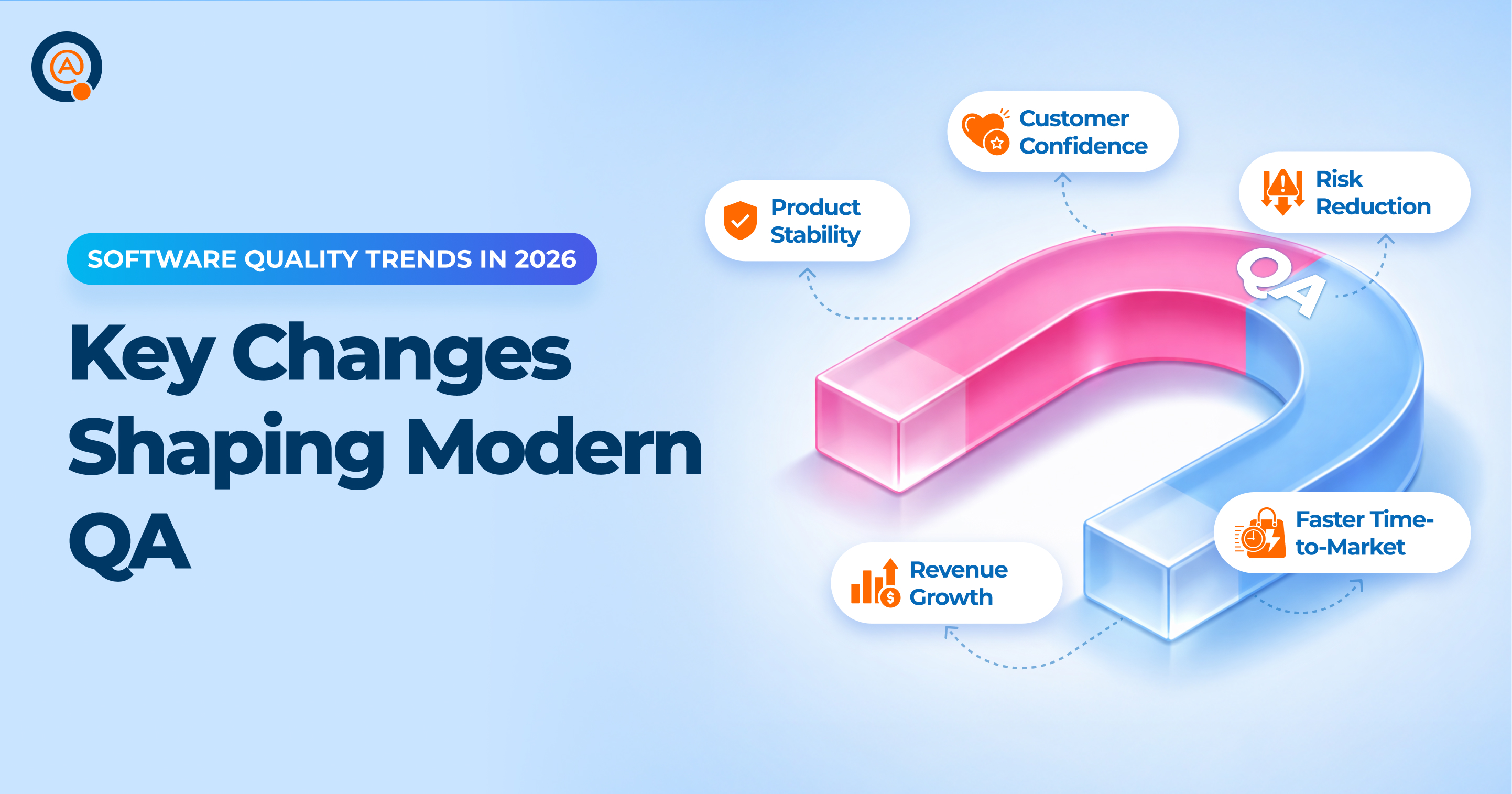
Across the tech industry, success is defined by how effectively companies balance speed, cost, quality, and risk, regardless of the year. What changes over time is how hard this balance becomes to maintain, as new technologies emerge, delivery cycles accelerate, and products grow more complex.
For this reason, testing has become more critical than ever. QA helps organizations maintain control during rapid change, support confident innovation, and translate technical complexity into measurable business value.
But, to continue delivering this support, QA practices must evolve as well. Below, we outline the key QA trends shaping 2026 and explain why adopting them matters for organizations focused on stability, scalable growth, and long-term product value.
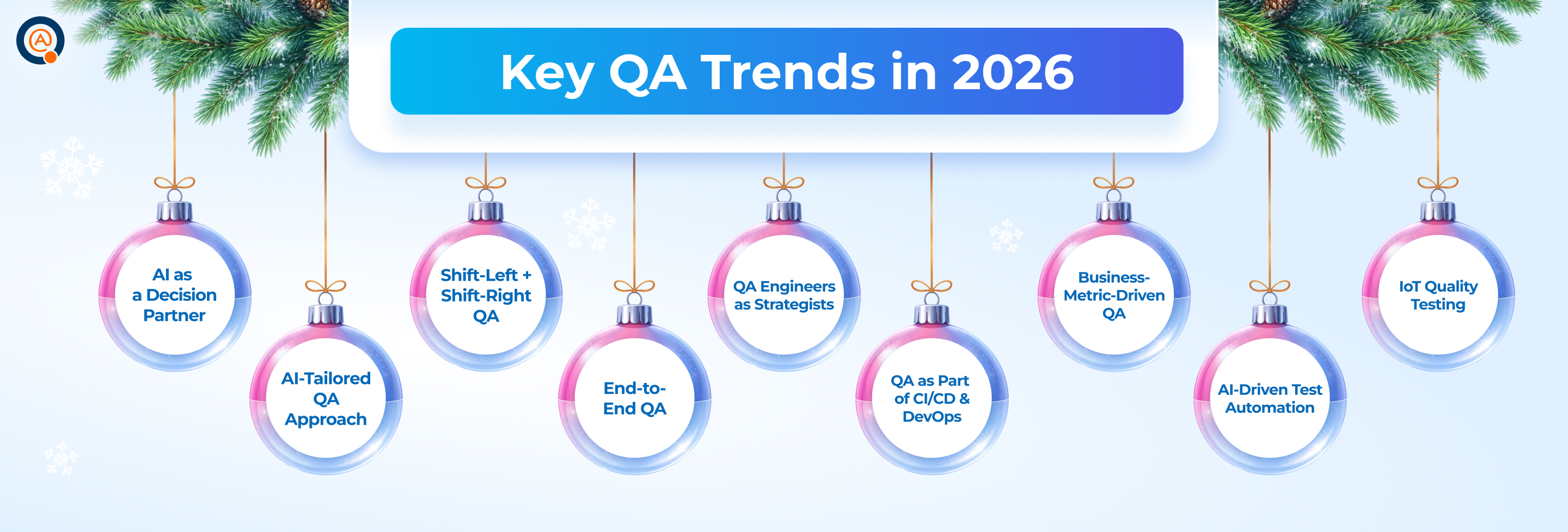
Key Software Quality Trends in 2026
AI as a Decision Partner in QA
AI continues to take a central role in QA, supporting teams by accelerating routine work such as test data generation, stabilizing flaky automation, and running repetitive checks at scale. This shift is not about replacing manual testers. The strongest results come from combining AI capabilities with human expertise. You can read more about our perspective on this topic here.
What is changing is how AI is used in QA. AI’s role is moving toward decision support. Modern AI systems analyze code changes, assess historical risk patterns, and help guide testing priorities. This shift positions AI as an active contributor to quality decisions, rather than a tool limited to task automation.
What This Means for the Business
- Higher accuracy with less effort
Intelligent automation improves test precision while reducing manual workload and operational overhead. - Predictive quality insights
AI analyzes historical data to surface risks early, enabling proactive fixes and lowering post-release costs. - More confident release decisions
Data-driven signals improve risk assessment and release predictability, aligning QA outcomes with business goals.
Managing AI Risk Through Dedicated QA
As AI-driven systems grow more complex, maintaining their reliability becomes increasingly challenging. Companies face issues such as unpredictable behavior, hallucinations, and inconsistent outputs that cannot be addressed by traditional testing alone. Covering these risks requires a dedicated testing approach tailored specifically to AI-based systems.
What This Means for the Business
- Clear visibility into AI readiness
Structured AI testing helps assess the current operational state of an AI agent and its behavior across scenarios. - Early detection of critical risks
Identifying weaknesses and high-risk areas early reduces the chance of unexpected failures after release. - Better preparation for launch and scaling
A well-defined testing approach helps teams make informed decisions and prepare AI systems for stable, controlled release.
Combining Shift-Left and Shift-Right
The traditional distinction between shift-left testing (focused on early validation) and shift-right testing (focused on production behavior) is no longer relevant. Modern QA integrates both approaches into a continuous quality loop.
- Left loop
Covers early validation during development through automated testing, API and integration checks, and static analysis before release. - Right loop
Focuses on post-release validation in production, using real usage data, system behavior monitoring, and resilience checks under live conditions.
What This Means for the Business
- Faster bug detection
Moving testing to the early phases of development lowers the chances of significant production failures. - Lower cost of fixing defects
Early testing reduces the cost of defect resolution and eliminates expensive late-stage rework.
- Shorter release timelines
Continuous testing helps teams avoid rework, enabling faster releases to production.
End-to-End Quality Validation
Managing quality across all components using fragmented tools has become increasingly inefficient. End-to-end testing platforms address this by consolidating functional, regression, API, performance, accessibility, and security validation within a single environment. This integrated approach streamlines quality workflows, reduces operational overhead, and ensures that testing reflects real user experience rather than isolated checks.
What This Means for the Business
- Simplified workflows with unified tools
A single platform reduces complexity and lowers integration and maintenance costs. - Reduced team overhead and quicker releases
Streamlined workflows save time and enable faster releases without quality trade-offs. - Enhanced customer loyalty through a better experience
End-to-end user journey validation improves satisfaction, conversion, and sales.
The Strategic Role of QA Engineers
The role of QA has expanded beyond traditional testing. Today, QA professionals design automation strategies, collaborate with AI systems, and interpret quality signals within a business context. Their focus is on turning AI-driven insights into outcomes that directly inform release decisions and deliver measurable results.
These capabilities are most commonly found at the senior level, which explains the growing demand for experienced QA engineers across the market. As this shift accelerates, organizations may face a new challenge in 2026: a shortage of specialists with the depth of expertise required to oversee AI-enabled quality processes confidently.
What This Means for the Business
- Strategic focus over routine tasks
A strategic QA role shifts effort from repetitive checks to risk assessment, release readiness, and decision support. - Better alignment with business objectives
QA insights are directly linked to business goals, enabling release decisions based on risk, impact, and value. - Faster data-driven decisions
Clear quality insights accelerate product and business decisions.
QA as Part of CI/CD and DevOps Pipelines
Quality can no longer be addressed at the final stage of delivery. Leading teams integrate QA directly into CI/CD workflows, where validation runs continuously as part of everyday development. By 2026, many large enterprises will use AI assistants within their pipelines to automate testing, analyze operational data, and support controlled-release strategies. In this model, QA functions as a core delivery capability. Each code change feeds a continuous learning cycle, enabling teams to identify issues earlier, adapt faster, and release with greater confidence.
What This Means for the Business
- Continuous quality checks for faster delivery
Quality validation built into CI/CD pipelines enables faster releases with controlled risk. - Lower production risks and fewer incidents
Automated quality gates significantly reduce the likelihood of production failures. - Rapid feedback and ongoing improvement
Fast feedback loops enable continuous product improvement and quicker response to change.
Quality Becomes a Business Metric
Software quality is no longer viewed only as a technical metric and is increasingly treated as a business KPI. According to Gartner [1], 81% of executives now link software quality directly to customer satisfaction and revenue, changing how QA outcomes are evaluated and discussed.
In practice, this shift means quality reporting now focuses on experience-driven indicators such as uptime, performance, accessibility, and overall user experience. As these metrics become part of decision-making, product strategy grows more customer-centric and more closely connected to measurable business impact.
What This Means for the Business
- Minimized losses from performance issues
Quality-focused metrics reduce financial impact from slowdowns, outages, or instability. - User-centered product improvements
Business-driven quality metrics guide product decisions toward better user experience. - Stronger brand reputation and retention
Consistently high-quality experiences build trust and improve long-term retention.
AI-Driven Test Automation
Test automation is moving into a more mature stage, shifting from isolated initiatives to coordinated, enterprise-wide strategies shaped by AI. This evolution enables organizations to shorten testing cycles, reduce operational costs, and gain greater confidence in product quality.
At the same time, AI-driven automation requires clear governance to ensure accuracy and alignment with business priorities. Without proper oversight, efficiency gains can introduce hidden risks. Companies that establish this balance in 2026 will build automation frameworks that scale with product complexity while remaining resilient and adaptable.
What This Means for the Business
- Dramatically reduced test creation time
AI generates tests faster, shortening development and release cycles. - Lower operational testing costs
Intelligent automation reduces long-term maintenance and operational expenses. - Scalable coverage without team growth
AI enables testing to scale with product complexity without expanding the QA team. - Greater adaptability to product changes
Adaptive automation improves resilience and maintains confidence as products evolve.
Managing Quality Across IoT Ecosystems
The growing adoption of connected devices is driving increased demand for IoT testing. As IoT ecosystems become more complex and widely used, ensuring reliable performance, security, and stability becomes critical for business operations.
IoT testing focuses on validating device behavior, connectivity, and system interactions under real conditions. By preventing unexpected failures and inefficiencies, it helps improve overall system productivity, enhances control over connected environments, and supports more efficient use of network and device resources.
What This Means for the Business
- Safer IoT environment
Early validation of device interactions and connectivity reduces security, stability, and integration risks in real-world conditions. - Better device performance
Resolving connectivity issues and ensuring proper component behavior improves response times, efficiency, and overall user experience. - Reduced system downtime
Proactive monitoring and testing help identify potential failures early, minimizing unplanned outages and operational disruptions.
Software Quality Trends We Already Apply as an Independent QA Partner
Applying AI-Tailored Testing Approaches
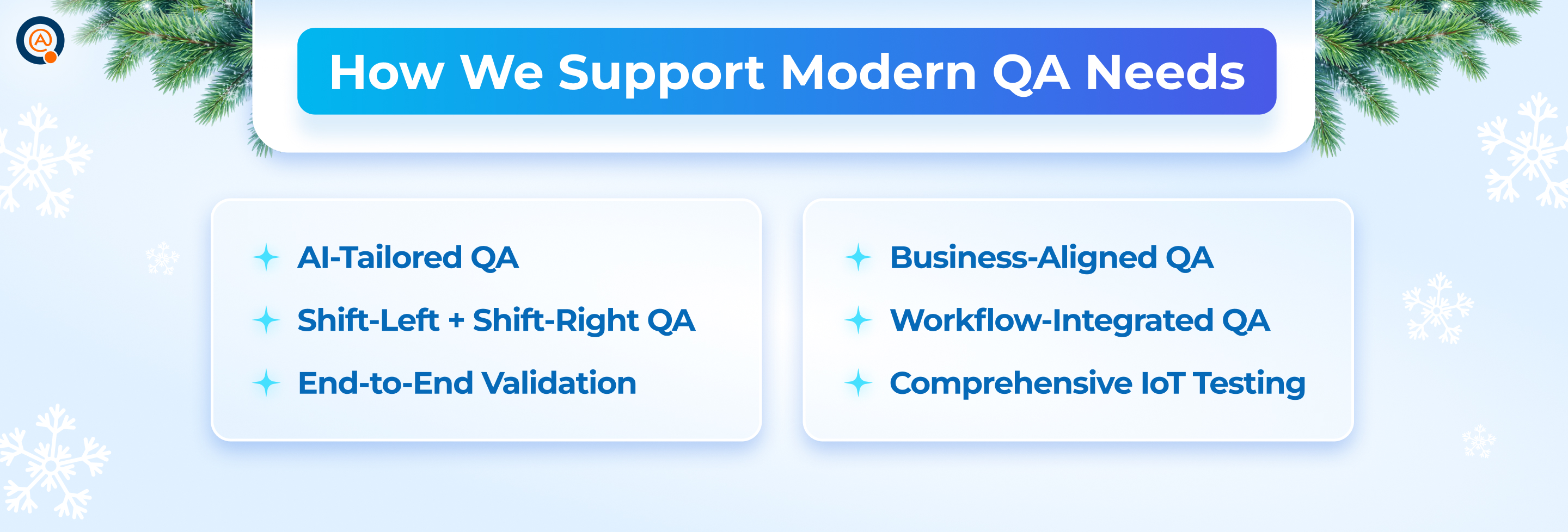
We apply a comprehensive QA approach that combines traditional testing practices with AI-tailored validation methods. This allows us to address the specific challenges of AI-powered products, including non-deterministic behavior, decision consistency, and evolving system logic.
Integration of Shift-Left & Shift-Right QA
We engage with partners from early ideation and design stages to identify risks, clarify quality scope, and align QA priorities before testing begins. At the same time, we support shift-right practices by validating product behavior in real conditions, using production data and usage insights. Through this approach, we help partners identify risks early and maintain consistent quality control throughout the product lifecycle.
End-to-End Product Validation
We provide end-to-end testing that covers functionality, integrations, performance, and accessibility across the whole user journey. This approach helps our clients gain a realistic view of product quality, identify risks across interconnected areas, and ensure that quality decisions reflect real usage scenarios and business priorities.
Aligning QA Workflows with Business Metrics
We always begin each engagement with a requirements analysis that covers business goals, client needs, and product context. These insights shape the QA approach we use throughout testing, enabling stronger, more consistent quality outcomes for our partners.
Seamless Integration into Client Delivery Workflows
We integrate seamlessly into client workflows, including Agile frameworks, CI/CD pipelines, and custom delivery processes. This flexibility allows us to align QA activities with existing operations, minimize disruption, and provide continuous quality validation without slowing down delivery.
Comprehensive Validation for IoT Ecosystems
We provide end-to-end testing for IoT solutions, covering the whole path from edge devices to cloud platforms. Our teams validate real-world performance, data flow, connectivity, and scalability across the entire IoT ecosystem, helping ensure stability and reliability in complex connected environments.
Conclusion about Software Quality Trends in 2026
As a new year approaches, it’s the right time to think about what will keep your product successful in 2026. As we’ve seen, testing practices that evolve alongside technology and business needs play a key role in ensuring stability, scalability, and confidence as products grow.
At QATestLab, we already apply modern QA approaches to meet evolving market demands. Moreover, we continuously monitor emerging trends and refine our practices to help our partners adapt with confidence and maintain consistent product quality.
If you require support with testing your product, our QA engineers are ready to apply proven and effective testing methods to keep your software competitive. Get in touch, and let’s work together toward long-term product success.

Learn more from QATestLab


Related Posts:
About Article Author
view more articles